
E80: Wavelets of Consciousness: The Field of Mind Expl...
The mind is a field of infinite energy that generates thoughts like wavelets or ripples in a lake. These wavelets are transient and harmless unless we hold them in place by focusing undue attention on them. Held in place, these wavelets freeze and become the mental patterns of our ego and belief systems, which distort our perception from then on. Liberation comes from learning to relax and not resist energy as it passes through, and by letting go of the older patterns as they arise.
For more information, go to michaelsingerpodcast.com.
© Sounds True Inc. Episodes: © 2025 Michael A. Singer. All Rights Reserved.

Honey Tasting Meditation: Build Your Relationship with...
There is a saying that goes “hurt people hurt people.” I believe this to be true. We have been conditioned, in environments of scarcity and violence, to react more with fear and self-protection than curiosity and connection. As a result, we live in a world that is deeply in need of more kindness, more ease, more connection, more sweetness. It’s time we offer more sweetness and ease to ourselves, to one another, to our planet.
Now, this does not mean being a Pollyanna or “sickly sweet.” It does not mean being addicted to sugar and finding other ways to hurt ourselves. It means moving through the world and offering sweetness to ourselves and others. It means setting good boundaries and protecting our community and the hive from those who would “rob” us of our sweetness, of the sustenance (love, connection, inclusion, belonging) that helps us endure.
But first, we have to allow ourselves to taste and feel the sweetness on our own. We have to practice being deeply grateful for what is sweet in our life, holding it with reverence, and freely sharing it with others.
We invite you to build your own relationship with, and deep worthiness of, sweetness. We invite you to find and taste the sweetness in your life. Times of abundance and sweetness are special, and we must remember to taste them fully and live into them. We must also remember to share them.
What sweetness do you have in your life? What sweetness can you share with others? What sweetness do you crave from others? How can you cultivate more sweetness in your life? What does that look, sound, and feel like? Where do you deny yourself sweetness? How can you give yourself permission to taste and share all of the sweetness that comes to you? How can you bring sweetness into the lives of others?
Honey Tasting Meditation
For this practice, you’ll need some (ideally) local honey. If possible, find out what you can about where it came from and what was in bloom at the time it was made. This will help deepen your relationship to the place you live. If you cannot find local honey, that is okay; you can still complete the meditation as instructed.
Find a quiet spot in a quiet moment and sit with your jar of honey. Before opening it, sit in a few moments of conscious breathing to quiet your mind.
Start with your sense of sight and smell. Hold the jar of honey up in front of you and observe its color and viscosity. Take note of how it looks in the light, in the dark.
Next, open the jar of honey and bring it to your nose. Inhale deeply. Notice the sensations, images, or thoughts that come to you as you breathe in the aromatherapy of the honey.
Now, reverently taste the honey. Take a small amount on a spoon and meditatively savor the flavors, sensations, feelings, and images that come to you. Chew the honey. Hold it on your tongue. Allow yourself to indulge in its many flavors. Do this again with another spoonful (or as many as you want) but take your time.
When you’re done, write down any messages or insights you received from the experience and the nurturing and healing power of the honey. Take this moment of sweetness with you into your day.
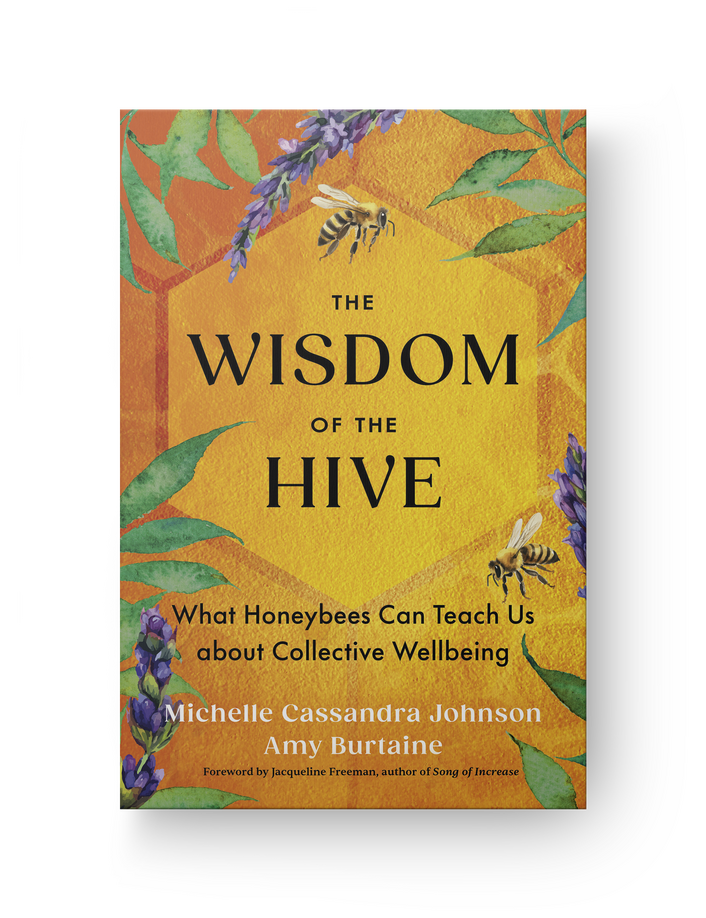
Excerpted from The Wisdom of the Hive: What Honeybees Can Teach Us about Collective Wellbeing.

Michelle Cassandra Johnson is an author, activist, spiritual teacher, racial equity consultant, and intuitive healer. She is the author of six books, including Skill in Action and Finding Refuge. Amy Burtaine is a leadership coach and racial equity trainer. With Robin DiAngelo, she is the coauthor of The Facilitator’s Guide for White Affinity Groups. For more, visit https://www.michellecjohnson.com/wisdom-of-the-hive.
Learn More
Amazon | Barnes & Noble | Bookshop | Sounds True
E79: Beyond the Mind: Escaping the VR of Thoughts and ...
Human beings are living inside a kind of “virtual reality” created by their own minds. This VR is built from thoughts, past experiences, emotions, and beliefs that they hold onto and identify with, forming their egos and self-concepts. Spiritual awakening involves stepping back from this constructed reality, witnessing it without getting lost in it, and ultimately letting it go to merge with a higher, freer state of consciousness. True liberation is compared to taking off the VR goggles and realizing the infinite reality beyond the limited personal world created by these mental constructs.
For more information, go to michaelsingerpodcast.com.
© Sounds True Inc. Episodes: © 2025 Michael A. Singer. All Rights Reserved.

Thomas Hübl: Healing Collective Trauma
Thomas Hübl is an Austrian-born contemporary spiritual teacher and the founder of the Academy of Inner Science. With Sounds True, he has recorded the audio training The Power of We: Awakening in the Relational Field and written a book titled Healing Collective Trauma: A Process for Integrating Our Intergenerational and Cultural Wounds. In this episode of Insights at the Edge, Tami Simon speaks with Thomas about healing collective trauma as the work of our time. They discuss how we can feel and are affected by major traumas of the past, even if we didn’t directly experience them, and the ways in which this contributes to our collective separation. Thomas also explains the concept of “retrocausality,” or the potential for the healing we undertake in our lifetimes to benefit our entire family lines. At a time when so much ancestral trauma, multigenerational trauma, and cultural trauma is in our midst, Thomas invites us to turn toward it and join together to heal and integrate the pain of the past as we create a different future.
S1 E2: Doing the Real Work to Free Yourself
According to Michael Singer, the only one stopping you from experiencing the heights of divine ecstasy and freedom is you. In this podcast, he describes the real work of the spiritual path as the process of removing our inner blockages and self-made obstacles in order to uncover the natural states of bliss and spiritual liberation that are our birthright. He also discusses discovering “witness consciousness,” the cause of karma, the art of relaxing and releasing resistance to our experience, and more.
For more information, go to michaelsingerpodcast.com.
© Sounds True Inc. Episodes: © 2024 Michael A. Singer. All Rights Reserved.
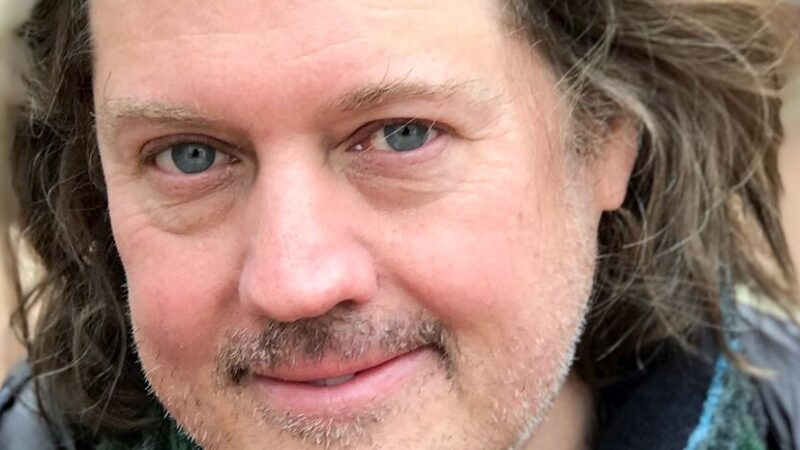
Matt Licata, PhD: The Alchemy of Befriending Ourselves...
Matt Licata is a practicing psychotherapist, a co-facilitator of a monthly online membership community called Befriending Yourself, and the author of The Path Is Everywhere. With Sounds True, he has written a new book titled, A Healing Space: Befriending Ourselves in Difficult Times. In this episode of Insights at the Edge, Tami Simon speaks with Matt about what it is to be a healing space, that is to hold space for ourselves and others, as well as how we can feel held by something greater than ourselves during challenging experiences. They also explore our inner wounds and self-abandonment, spiritual bypassing and the ways in which many practices allow us to gloss over the real healing needed, and how coming into an embodied state can open us to greater inner depths. Finally, Tami and Matt discuss becoming an alchemist of your own life, discovering the inner gold that each of us has within, and befriending all of ourselves.