
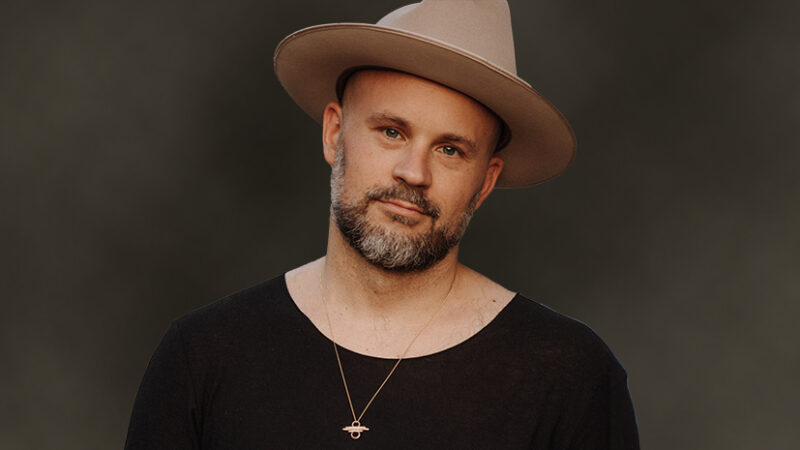
James McCrae: Why We Need the Art of YOU
Where does creativity come from? How do we uncover our authenticity and deepest expression in a society that would have us cover it up to fit in? What is the connection between creativity and healing? Join Tami Simon in conversation with poet, artist, and author James McCrae as they discuss these questions, the role of the artist today, and his new book, The Art of You: The Essential Guidebook for Reclaiming Your Creativity.
A wonderful listen for creatives of every type and anyone who’s ever had the thought, “I’m not creative,” Tami and James talk about the courage to choose authenticity; the magnetic nature of vulnerability; creativity as a spiritual path; intuition as a portal to the invisible dimensions; emotion: the energy that fuels creativity; shadow work and the “creative purge”; the yin and yang of creativity; cultivating the soil; giving your ego the appropriate job; the metaphor of the sunflower; listening: the first stage of creativity; social media, art, and technology; viral ideas and the origination of the term meme; curiosity and the spirit of exploration; and more.
Note: This episode originally aired on Sounds True One, where these special episodes of Insights at the Edge are available to watch live on video and with exclusive access to Q&As with our guests. Learn more at join.soundstrue.com.

Ep 5 Bonus: Breathing Through
This bonus episode will support you to take the main insights from Episode 4: There is No Future if We Go Numb and Episode 5: This Pain Is Not for Nothing, deeper into your life.
Both of these episodes are about the second phase in the Spiral of the Work That Reconnects, Honoring Our Pain for the World. This bonus is a recording of Joanna leading a meditation called Breathing Through, recorded at a retreat in 2006. In it, she’ll guide you to create space to acknowledge and honor the pain for the world that you carry without numbing or getting overwhelmed. All you’ll need for this bonus exercise is a place where you can close your eyes and relax.
We recommend starting a podcast club with friends or family to do these practices together. Links and assets to help prompt reflection and build community can be found with every episode on WeAreTheGreatTurning.com.

Ep 5: This Pain Is Not for Nothing
Now we get to what may be the toughest part of reckoning with our planet’s situation: dealing with numbness, grief, and despair. It’s easy to feel overwhelmed by the enormity of the many crises around us, and natural to want to numb ourselves to the pain.
Joanna and Jess speak with great vulnerability and candor about what it takes to navigate our darkest feelings—and the strength and beauty that can be found when we honor our pain.
Trigger Warning: In this episode, we discuss suicide.
In this episode:
- When it feels like our pain could swallow us whole, it helps to remember that all feelings come and go
- Desperation can take us to dark places, but we are more than our despair
- Numbness—Jess opens up about her familiar tactic for escaping pain
- Our pain becomes sacred when we allow it to deepen our connection with the world
- Bonus Exercise: Breathing Through
We recommend starting a podcast club with friends or family to do these practices together. Links and assets to help prompt reflection and build community can be found with every episode on WeAreTheGreatTurning.com.

Sah D’Simone: Becoming Spiritually Sassy: Awaken...
Sah D’Simone is a spiritual guide, meditation teacher, transformational speaker, and bestselling author. Born in Brazil, Sah moved to the US when he was 16. Today, he leads a heart-based healing movement rooted in tried-and-true techniques, pioneering a spiritually sassy approach in which joy and authenticity illuminate the spiritual path. In this podcast, Sah speaks with Sounds True founder Tami Simon about his new book, Spiritually Sassy: 8 Radical Steps to Activate Your Innate Superpowers. Tami and Sah also discuss: the importance of reclaiming beauty, playfulness, and lightheartedness on the spiritual path; what it means to be a “joy activist”; Sah’s journey to becoming a spiritual teacher; the innate goodness within each one of us; forgiving the past; the evolution of Indian teachings in the West; the “spiritually sassy” glossary of terms; and much more.

Yuria Celidwen, PhD: “Flourishing Is a Gradual U...
Dr. Yuria Celidwen is at the forefront of a historic expansion in the field of contemplative science—or the study of inner practices like meditation, prayer, and mindfulness. Until recently, researchers have primarily focused on major religious traditions such as Buddhism or Christianity. Today, Dr. Celidwen is bringing the long-overdue perspective of Indigenous cultures into the discussion. In this podcast, Sounds True founder Tami Simon speaks with Dr. Celidwen about her new book, Flourishing Kin: Indigenous Wisdom for Collective Well-Being.
Tune in for this invigorating conversation exploring: Yuria’s definition of flourishing as a gradual unfolding of aesthetic arrest; cultivating an embodied sense of your interconnection with all of creation; why Indigenous perspectives are vital for solving the climate crisis; honoring spirit, the animating principle of life; a deeper understanding of health; the direct experience of “moments of truth”; sunshine as a seed of awareness; the core right of self-determination; relating to Indigeneity respectfully; the possibility of collective flourishing; and more.
Note: This episode originally aired on Sounds True One, where these special episodes of Insights at the Edge are available to watch live on video and with exclusive access to Q&As with our guests. Learn more at join.soundstrue.com.
I Did a 40-Day Rest Cleanse and Here’s What Happened
For 40 days, I had the most soulful rest. And I did it in the comfort of my own home, with a full-time job, a family, and a social life.
Every day I awoke around 5:30 am and tiptoed to my Rest Cave (set up in a corner of our spare room). I laid on my back on an exercise mat (under my favorite blanket with a sleep mask) and plugged earbuds into my phone. Then I hit play on Karen Brody’s Daring to Rest yoga nidra meditation and let her soothing guidance lull me into a state of deep rest—or as Karen puts it, a return to myself. If you’re not familiar with yoga nidra, it’s a meditative practice for entering one of the deepest states of relaxation imaginable. And you do it lying down.
I’m not a morning person, but getting up to lie down (ironic, right?) was lovely. The stillness of the early morning quickly became my friend.
For the first 15 days, I listened to the Rest Meditation (20 minutes) to shed physical exhaustion, followed by 15 days of the Release Meditation (30 minutes) to let go of limiting beliefs. The last 10 days consist of the Rise Meditation (40 minutes), allowing life purpose exhaustion to lift, so that you can hone in on your true-hearted desires. Every five days I read a chapter in the book itself, Daring to Rest, for insight into what I was experiencing and supportive practices.
Gradually these aspects of my life began to shift—providing a depth of experience new to me, and oh so, beautiful.
- An underlying sense of sweetness in my day. I discovered a natural flow to my day, felt light and at ease in my skin, and second-guessed myself less.
- Deep intuition. Karen guided me to breathe in through my heart, then follow my breath, see where it landed, and listen for what she calls a “soul whisper”—a word or image that offers a clue to how you’re really feeling. Some days all I could think about was my to-do list or obsess over a worry. But when my soul whispers did arrive, they were often crystal clear and I journaled about them.
- Patience and connection. Mornings were less frantic. When my seven-year old son had stressful moments getting ready for school, I felt calmer and more present for him. When we walked to the bus stop, my awareness of the outdoor world was more acute—the blue sky, cloud formations, the crescent of a morning moon.
- Craving control. On days when I felt overwhelmed or anxious, my inclination to relieve those feelings with a glass of wine or binging on television lessened. Sometimes I would simply sit, gaze outdoors, and do nothing more. In those moments, I loved not feeling the need to do anything—not clean, not sort the mail, not check Facebook. I began to understand rest outside of my Rest Cave.
- A connection to beyond. This was a big one. Karen calls it your “council of women” and teaches you to summon it for love and support. It can be women in your circle, women who have passed, even women you don’t know personally. I saw my grandmother (who died before I was born) looking at me lovingly and felt my sister-in-law, who I’ve known since I was a baby, standing beside me. At times the feeling of these and other women was so strong that tears ran down my cheeks.
While my life became deeper and rosier, it was not until I went cold turkey for a few weeks that I realized just how powerful this rest cleanse was. I’ve always been someone who can go the distance, then neglect the sustaining part, like training for a half-marathon but not running for months after the race. And it’s so easy to fall back into old habits.
So now I’m learning how to translate this cleanse into an ongoing practice, for which Daring to Rest offers sound insights. My Rest Cave is an essential element. It’s not only a dedicated space for yoga nidra, but one for self-care in general—to journal, to listen to music, to just be.
Karen ends every yoga nidra meditation with the words, “Be good to yourself.” And in that spirit, I invite you to download her free Rest Cave Guide to create your own. And once you do, I dare you to rest and see what happens!
Christine Day has been a member of Sounds True’s sales and marketing team for more than five years and loves diving into our books on a personal level to learn both theory and practice. She also works on Sounds True’s children’s books and enjoys doing storytimes at her son’s elementary school.
