

Many Voices, One Journey – a free eBook
In the spirit of the rich tradition of contemplative reading, Sounds True‘s authors and editors have compiled these essential written selections for your illumination, enjoyment, and inspiration. Many Voices, One Journey, a free eBook, features the writings of Jon Kabat-Zinn, Adyashanti, Sharon Salzberg, Gangaji, Jack Kornfield, and others. We hope you find in their words helpful guidance for your own journey.
Many Voices, One Journey includes:
1. “Adjusting Your Default Setting” from Mindfulness for Beginners by Jon Kabat-Zinn
2. “What’s Love Got To Do With It?” from Living Nonviolent Communication by Marshall Rosenberg
3. “Grace Is All Around Us” from Falling into Grace by Adyashanti
4. “Surrender Only into Love” from Finding God Through Sex by David Deida
5. “The Longing to Become Who We Are” from Touching Enlightenment by Reginald A. Ray
6. “What Is Your Story?” from The Diamond in Your Pocket by Gangaji
7. “The Healing Power of Self-Compassion” from The Kindness Handbook by Sharon Salzberg
8. “The Five Stages of Radical Forgiveness” from Radical Forgiveness by Colin Tipping
9. “On Contemplation” from Choosing to Love the World by Thomas Merton
10. “The Wisdom of Our Difficulties” from A Lamp in the Darkness by Jack Kornfield
11. “Entering the Cave of the Heart” from Meditation for the Love of It by Sally Kempton
12. “A Source Beyond Ego, a Grace Beyond Luck” from Life Visioning by Michael Bernard Beckwith


Erotic Authenticity: Replacing Shame with Celebration
Sometime last year, I was having a conversation with a close relative of mine. I had sent them a recent news story I was quoted in and had been met with… silence. Eventually, I nudged a little bit and they responded, saying “I’m sorry, I just can’t be proud of someone who talks about sex and sex toys for a living. It’s embarrassing.” As we unpacked this statement, it became clear that they were unable to see the good—any good—in my work. As a therapist, as a writer, as an educator… my work was shameful in their eyes. In that moment, I understood my clients in a way I never had before.
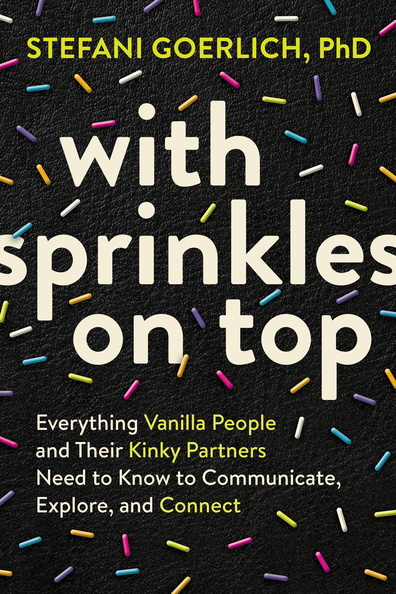
With Sprinkles on Top was already finished by the time this occurred, but if it hadn’t? This conversation would have inspired me to write it. It can be incredibly painful to have someone you love tell you that “What you do is wrong. Who you are is not OK.” Many kinky people are afraid that if they share their innermost selves with the ones they love most, they too will be rejected, written off as broken or creepy or wrong. I wrote Sprinkles because I believe deeply that every single human being deserves to feel loved and worthy and whole, to know that their innermost desires are not just valid but beautiful, and to find others who can celebrate this beauty and their relationships together with them.
Sprinkles is also written for the partners of these kinky people, many of whom tell me that, if their spouse had just been willing to share their desires, they would have happily explored with them. For the spouses who don’t understand the fantasies or intimate practices they’re learning about and who need a guide to help them navigate these new relationship waters. For the men and women who call my office afraid—afraid that there’s something wrong with their partner or something inadequate in themselves.
They want me to “fix” them. I want to celebrate them.
With Sprinkles on Top is not a “how to” book. It’s a “what now?” book. My goal is to celebrate the things that make each person and each relationship unique and delightful—and to help them discover new unique qualities in themselves and new ways to delight one another. I want to celebrate vanilla relationship values while also normalizing and affirming kinky identities. I want to help my readers find new and exciting ways to enhance their own core sexual and relational “flavor” through interactive activities they do by themselves and with their partner.
Differences in desire represent an exciting opportunity to strengthen and reinforce the bonds of intimacy and trust we have created within our relationships, while also expanding the erotic playground we enjoy together. We don’t have to change who we are. We don’t have to be ashamed of what we want or embarrassed to talk about it. Sexuality, desire, and intimacy are, to me, sacred gifts. I’m honored to be able to help my readers, my clients, and others to build happier, healthier relationships with their bodies, their partners, and themselves. I hope you enjoy the process of finding your sprinkles and using them to communicate, explore, and connect with the one(s) you love.
Kol Tuv,
Stefani Goerlich

Stefani Goerlich, PhD, LMSW-Clinical, LISW, LCSW, CST, is a certified sex therapist and master social worker who specializes in working with gender, sexuality, and relationships. She is a sought-after clinical supervisor, media consultant, and conference presenter who has appeared in media ranging from CNN and the Washington Post to Cosmopolitan and Teen Vogue. She is the award-winning author of the professional books The Leather Couch and Kink-Affirming Practice.
Author photo © Kim Williams
With Sprinkles on Top

Are You Suffering from Empathic Distress? How to Reclaim Your Boundaries Compassionately
Are you exhausted, anxious, or overwhelmed? Maybe your life is challenging. Or perhaps the state of the world and others’ suffering feels unbearable. If your life is going well, but you still feel miserable, maybe you have some guilt or shame. You are not alone. You may be suffering from empathic distress.
Most of us have been taught that empathy is wholly positive and should be fostered in children and revered in adults. This idea is partly correct. The absence of empathy is clearly problematic. When the ability to sense or care about others’ feelings or pain is missing, we edge into sociopathy. However, empathy is experiencing another person’s pain as our own. In small doses and for short periods, it allows us a deeper understanding of our fellow beings. But it can also make it harder to help, because the pain is spread around, not diminished. If your friend breaks their leg and you experience genuine empathy, it might feel like your leg is broken too. This makes it harder for you to function and definitely harder for you to help them.
Empathy can make us sick, overwhelmed, and burned out.
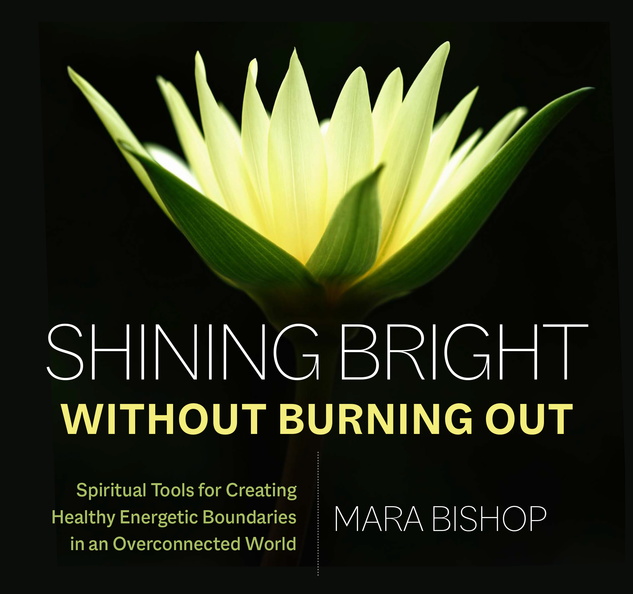
Many people feel helpless in the face of the magnitude of suffering in the world today. It can result in what appears to be apathy at first but is actually empathic distress, which means “hurting for others while feeling unable to help.” An op-ed in the New York Times titled “That Numbness You’re Feeling? There’s a Word for It” described this phenomenon and cited some of the research I used to create the Sounds True audio course Shining Bright Without Burning Out: Spiritual Tools for Creating Healthy Energetic Boundaries in an Overconnected World.
The Research
Neuroscientists Olga Klimecki and Tania Singer identified empathy as a contributing factor to burnout, primarily but not exclusively, among healthcare workers and therapists. The older term compassion fatigue is a “misnomer.” Compassion and empathy have distinctly different impacts on our bodies and psyches. Compassion is witnessing and being willing to help when possible and appropriate. Empathy is taking on others’ pain as our own. Empathy often creates “more distress.” It is a huge distinction.
Empathy is overrated and fatiguing. Compassion is what we need. Unfortunately, we often confuse the two. This dynamic is one reason why developing healthy energetic boundaries is essential.
Decreasing Empathic Distress
Being unable to adjust between compassion and empathy is a big reason many people feel drained and overwhelmed. Research about the critical difference between compassion and empathy aligns with many spiritual concepts of energetic boundaries. It also challenges some. One of the ways we inadvertently make things difficult for ourselves is when we believe that to be good, kind, “spiritual” people, we must always be wide open. We must be at one with the universe, be open to everyone, and say yes to everything. There is a paradox here. We are all one on some level, but we need to embrace the ability to differentiate ourselves from others at times to steward our own health.
We have reached a tipping point with empathic distress; it is a crisis within the crises.
Klimecki and Singer focus on how training in compassion meditation can help reduce empathic distress, shifting from an experience of absorbing others’ energy to a state of kindness toward others with clear self-differentiation. The distinction between empathy and compassion is one of the first things we cover in Shining Bright Without Burning Out: Spiritual Tools for Creating Healthy Energetic Boundaries in an Overconnected World. The course also includes a full set of tools for addressing empathic distress from the perspective of energetic boundaries.
Here are a few additional steps you can take today to begin reducing empathic distress:
- Be clear about your direct responsibilities and what is not yours.
- Pause before entering new situations: conversations, appointments with clients, meetings, etc. Take a moment to reset yourself with a breath and an intention for how you want to engage.
- Pay attention to how you feel after interactions with people, places, and media. Note over time when your mood or body feels drained so that you can prepare more thoroughly in the future, consider how to minimize those interactions if they are optional, and take time to reset after engaging.
Mara Bishop
Mara Bishop is a shamanic practitioner, intuitive consultant, teacher, author, and artist. In private practice, she uses her Personal Evolution Counseling™ method to provide an integrated approach to spiritual healing, personal growth, and emotional well-being. Her books Shamanism for Every Day: 365 Journeys and Inner Divinity: Crafting Your Life with Sacred Intelligence are resource guides for spiritual practice. She resides in Durham, North Carolina. For more, visit wholespirit.com.
Learn More
Sounds True
The Purpose of Life is to Love
Within all of the great wisdom traditions we find an emphasis on love, kindness, and opening our heart to others. It is quite natural to open in this way to our family and friends, but what the great traditions teach is that this reservoir of love inside us is unlimited, extends to all living beings, and even to the universe itself. This reality of love is not an abstract experience, notes respected meditation teacher Reggie Ray, but something that is alive the core of who and what we are. One way to envision the spiritual journey is as a pathway which unlocks the love in our hearts, thereby enabling us to become fully human.
Please enjoy this short video from Reggie on the unfolding of love.
Transform your relationship with your kitchen—and your life
Hello gorgeous community of amazing human beings,
For the last 15 years, I have been cooking up this question:
What does it look like to nourish YOU?
Let’s drop everything we might think this is
and everything you didn’t get done today
and bring our collective shoulders down from the sky.
Let’s take a minute here. We are just getting started, yet I feel we need to slow down. Will you take a deep breath with me? Thank you for being here with me. Thank you for breathing. There is nothing to do here.
You can bring your awareness to your breath with an inhale through your nose. Open your mouth slightly and exhale with a HAAAAAAAAA sound. It feels so good to drop everything and breathe. Me too. To let go, even a little, is a real lovefest for the heart and mind = heart mind.
It feels so good, can we do one more?
You can close your eyes this time if you want to—
I will be right here.
We are just getting here, together.
Now let me ask you again:
What does it look like to nourish YOU?
What if I told you that your kitchen is a place of stories, mothers, grandmothers, imprints, and emotional weather patterns that shaped how you live now? It is also a place to deeply nourish yourself and cook up the life you have been longing to live.
Your kitchen (yes your kitchen!) is a fierce, unconditionally loving mother holding what is ripe and ready to become inside of YOU. Who would have thought that you can heal your life in your kitchen? I did! And now you can.
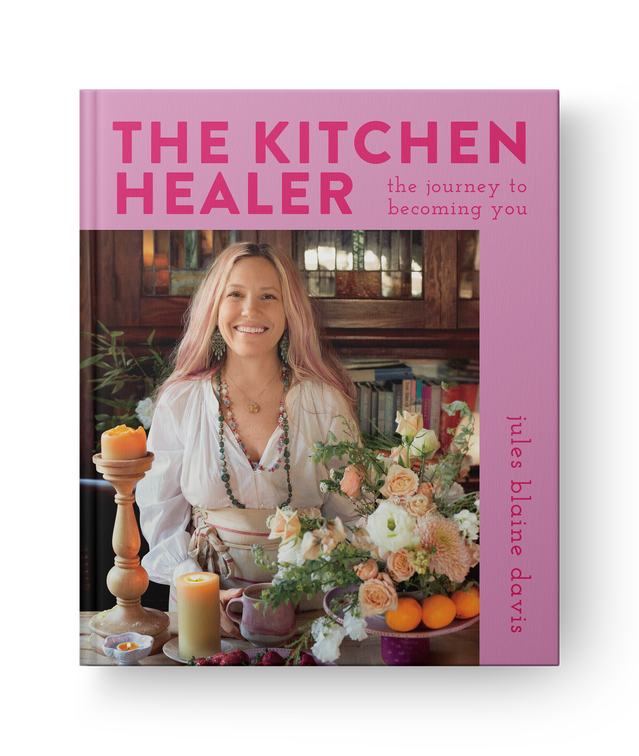
I am excited to share my new book: The Kitchen Healer: The Journey to Becoming You.
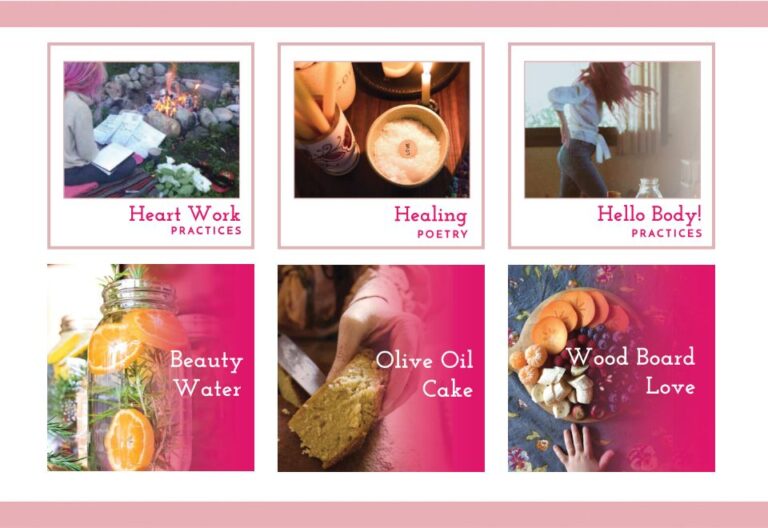
It invites you to bring your entire body into the kitchen, put your shame into the fire, offer your grief to the soup—allowing all you have been hungry for to begin to feed YOU. As you turn on the fire, you will come home to yourself. You will make the room you need, to hear and see and feel the stories you have been carrying.
You will begin, again and again, to become YOU.
Welcome home.
In loving service to your courage, your kitchen healer,
x x x x jules
Jules Blaine Davis, the Kitchen Healer, is a TED speaker and one of Goop’s leading experts on women’s healing. She has led transformational gatherings, retreats, and a private practice for over fifteen years. She has facilitated deeply nourishing experiences at OWN and on retreat with Oprah Winfrey, among many other miracles. Jules is a pioneer in her field, inviting women to awaken and rewrite the stories they have been carrying for far too long in their day-to-day lives. She is cooking up a movement to inspire and support women to discover who they are becoming.
Learn More
Amazon | Barnes & Noble | IndieBound | Bookshop | Sounds True

Meet the Author of . . . A Healing Space
The Author
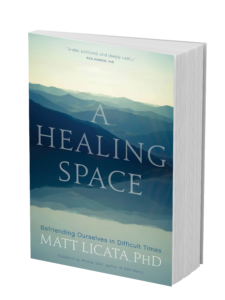
Matt Licata, PhD, is the author of A Healing Space: Befriending Ourselves in Difficult Times, coming out in November, 2020. In addition to being an author, he is a practicing psychotherapist and hosts in-person retreats. His work incorporates developmental, psychoanalytic, and depth psychologies, as well as contemplative, meditative, and mindfulness-based approaches for transformation and healing. He co-facilitates a monthly online membership community called Befriending Yourself, is author of The Path Is Everywhere, and is the creator of the blog A Healing Space. He lives in Boulder, Colorado. For more, visit mattlicataphd.com.
The Book
Is healing a matter of solving a problem, curing a sickness, or making our wounds disappear? “In my experience,” writes depth psychotherapist and meditation teacher Matt Licata, “true healing is not a state where we become liberated from uncomfortable feelings, but one in which we are free and flexible to welcome our complete experience—whether happy or difficult—more fully.” With A Healing Space, Dr. Licata invites us to explore a more vital sense of wellness—one that does not put us in opposition to life’s hardship, but instead welcomes all experience as part of the soul’s majestic vastness.
Are you learning any new tricks or skills during this time (COVID)? Has your book taken on a new meaning in the world’s current circumstances? Is there anything you would have included in your book if you were writing it now?
One thing I’ve been struck by in this time of COVID is just how formative, powerful, and challenging solitude can be for each of us, and how through confronting our aloneness we will inevitably meet parts of ourselves that we had lost contact with in times of status quo. As relational beings, wired to connect and co-regulate with one another, it can be so counter-instinctive to be alone, for there to be an absence of “good others” in our lives, and how much we take this for granted.
What has become a lot clearer to me is how we can call on these “internal others” who, through many moments of kindness, attunement, empathy, and compassion, reside as an “internal network” within us, and how important this can be in times of physical separation—and how truly available they are, even from afar, in ways that might surprise us.
I’m happy that A Healing Space is coming out during this time as it is centered around the art and practice of “befriending” and what that might mean in our contemporary world. Had I known that we would be sheltering in place and social distancing as we are, I would have more explicitly addressed the unique ways that isolation, solitude, and even loneliness can serve as actual allies on the path of awakening and healing, portals or doorways to a more merciful, wise, and compassionate relationship with ourselves and others.
What is one unexpected thing or habit that inspires your writing practice?
So much of my writing comes out of conversations I have with others—friends, family, students, clients, and even strangers. I often find myself deeply curious and even in awe at how others find meaning in their experience, make sense of it, and organize it in ways that are similar—and also at times quite different—to my own.
There’s something about being in conversation that opens me to another person’s heart, to their soul, to their psyche, and I often leave a conversation with new ideas, lenses, or reality tunnels, which I tend to explore via image and language.
It’s sometimes not easy for me to “sit down and write” in a general and abstract way. It requires live interaction with another human being or with the natural world in order to flow. It’s almost like I wait to hear a certain whisper or inner song that arises from conversation and quickly scramble to be the scribe for that to come into the world.
If there is a book that started your spiritual journey, what was it? How old were you, and how did you discover it? How would you describe its impact?
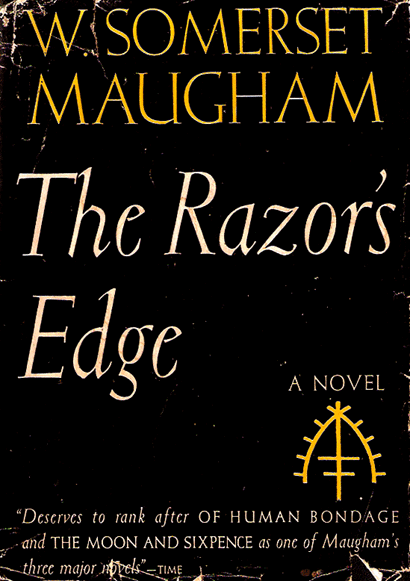
The first overt “spiritual” book I remember reading was in my senior year of high school: The Razor’s Edge, by W. Somerset Maugham. I would have been 17 at the time and had always been a bit of a dreamer with a vivid imagination and deep curiosity and wonder as to whether I really belonged in this place.
It was an identification with the protagonist, Larry Darrell, that catalyzed a certain longing in me, a knowing that there was more to this life than it appeared. To this day, I can return to some of those feelings I felt at the time, an opening or crack in reality, you might say, that invited me into a life of deeper meaning, magic, and aliveness.
I reread the book while traveling in India in my early 20s and continued my connection with Maugham and with Darrell, especially with Larry’s journeys in India himself. I had a kindred spirit out there somewhere and I remember that meaning a lot to me at the time, that there was at least one other person who wondered and wandered in the same way that I did.
Learn More
Sounds True | Amazon | Barnes&Noble | Bookshop | Indiebound