

Medicine Meets Meditation – with Drs. Andrew Weil and Jon Kabat-Zinn
Dear friends, enjoy this short exchange between Drs. Andrew Weil and Jon Kabat-Zinn on medicine and meditation. Jon and Dr. Weil have published a fascinating audio program with Sounds True entitled, “Meditation for Optimum Health: How to Use Mindfulness and Breathing to Heal Your Body and Refresh Your Mind.”
Andrew Weil: I’ve always been interested in the fact that there is a linguistic link between the words “meditation“ and “medicine.“ Both of them arise from a Sanskrit root that also has given us the English word “measure.“ And while it’s impossible to pin down the exact meaning of that ancient Sanskrit root, it seems to have to do with thoughtful action to establish order. Implied is a sense of some kind of active process: it’s work-action of some sort with a goal in mind, and the goal is creating order. So medicine and meditation are both different expressions of that kind of process in different realms.
Jon Kabat-Zinn: Adding to what Dr. Weil has said, I believe the common root “to measure“ has something to do with the platonic notion of “right inward measure.“ And so medicine is the restoring of right inward measure or order when our health is disturbed in some way. And meditation is, in my mind, the direct perception of right inward measure.
Sounds True: Is there specific evidence that meditation can impact health?
Andrew Weil: There actually has been a great deal of medical research on the health benefits of meditation. One of the researchers who has established a reputation in this area is Herbert Benson at Harvard Medical School. Years ago, he described what he called “the relaxation response,” which was a set of physiological changes correlated with a particular type of meditation, namely transcendental meditation, which involves repetition of a mantra. And the typical changes that were seen were a slowing of heart rate, a slowing of respiratory rate, and a decrease in blood pressure. So I think in very simple terms, meditation is a way of engaging the relaxation response, a way of decreasing chronic, nervous driving of the cardiovascular and digestive systems.
Jon Kabat-Zinn: When we’re so busy, running here and there, that can be tremendously problematic in terms of our overall health—mental, physical, psychological, and spiritual. When we get really driven on automatic pilot, trying to get someplace else all the time, without being attentive to where we already are, we can leave a wake of disaster behind us in terms of our own health and well-being, because we’re not listening to the body, we’re not paying attention to its messages; we’re not even in our bodies much of the time.
Mindfulness—paying attention on purpose in the present moment nonjudgmentally—immediately restores us to our wholeness, to that right inward measure that’s at the root of both meditation and medicine.
More from Meditation for Optimum Health
The same ability that helps ordinary men and women achieve extraordinary success is also the secret to optimizing your life span, letting go of stress, and even enhancing your body’s self-healing powers.
In Meditation for Optimum Health, you will join bestselling authors Dr. Andrew Weil and Dr. Jon Kabat-Zinn for a practical introduction that makes it simple to enjoy the life-changing benefits of meditation even if you’ve never tried it before.
How does meditation work? Can anybody do it? What do I need to get started? Is it religious? Does it have the power to heal? In alternating sessions, Dr. Weil and Dr. Kabat-Zinn give you straight answers to the most common questions about meditation, and dispel the myths and misconceptions surrounding this time-honored practice.
By learning to cultivate the power of your attention through daily practice, you can harness the full potential of your mind, and use it to enrich every dimension of your life. You will learn how meditation can actually unify your mind and body’s many related functions and help you start enjoying the best health of your life.
Complete with real-life examples, and a proven program of step-by-step meditations to get you started, here is the perfect introduction to the oldest and most effective system for feeling better, naturally: Meditation for Optimum Health.

The End of All-or-Nothing, Emergency Self-Care
What message are you giving to yourself when you wait until you’re in crisis before you begin caring for yourself? I used to be deeply entrenched in this pattern. I’d care for myself just enough so that I could be productive again and then get back to work until my next care emergency. I’d crash from striving and producing without a thought to my needs and then stop just long enough to treat myself just kindly enough to nurse myself back to health so that I could resume my breakneck speed.
Those days were exhilarating because even in my burnout I felt so purposeful, high on how good I was at pushing my needs aside to tackle whatever needed tackling. Exceptionally good in a crisis, I felt born for running myself into the ground and then picking up the pieces just enough to get back to work. Even as this pattern started to break down for me, I could feel my ego attachment to it. I was good at getting things done. I was good at helping others. I was good at putting everyone else’s needs ahead of my own. I was good. I was good. I was good.
The tricky thing about this pattern is that needs will get met one way or another. They don’t just vanish or disappear when you ignore them. They become rowdier and rowdier, nipping at your heels as you try to outrun them. Your body is infinitely wise and makes more noise as your ache for care compounds itself. When you ignore your needs long enough, you will be forced to prioritize yourself by circumstance, illness, or burnout, bringing you abruptly to the crisis point of having to slow down.
But even in the face of that, attending to the need for sustenance can sometimes still feel impossible if you are exhausted from a lifetime of holding it all together. While the need for sustenance might seem to come before rest, [in my book Needy] I ordered these chapters deliberately [“Rest” coming before “Sustenance”] because having the energy to start asking big questions about what you need requires energy too. You’re crumbling beneath the weight of your conditioned expectations for yourself and others, and you judge yourself for not being about to do it all without a thought for the energetic capacity necessary to prioritize joy, pleasure, or satiety.
You might think, Well if it’s right, it should feel good or it should be easy. But tending to your needs can be almost boring, and having the capacity to investigate the larger picture of what you are hungry for requires energy. It requires stamina and self-awareness to develop a healthy relationship with yourself after being in a dysfunctional relationship—one that’s chaotic, intense, familiar, thrilling, and compelling even when you know there is no way it will all work out in the long run. After a dramatic relationship like that, a relationship in which you are respectful of each other, loyal, trustworthy, and committed to each other can feel boring—but that kind of steadfast love heals and rebuilds a steady foundation of trust. The same is true for your relationship with yourself.
Self-love so often isn’t a flash-in-the-pan,
Instagram-worthy, wait-until-the-moment
is-perfect-and-the-stars-align kind of love.
It’s about showing up for yourself each and every day and doing what needs to be done. Maybe that’s resting. Maybe that’s calling your lawyer. Maybe that’s dealing with the window that is leaking and the moldy floorboards. Taking care of yourself is showing up for your relationship with yourself each day, asking what needs to be done and doing that to the best of your abilities.
It can be mundane, but as you begin making these shifts for your own sustenance, you might find yourself softening into a rhythm and routine of caring for yourself this way.
There is a deliciousness in knowing you will be there when you need yourself. There is a sense of safety in the self-trust you build each time you choose not to abandon yourself. This work can be messy but also joyful, silly, sexy, creative, and playful. You might find yourself enjoying the celebration of infusing pleasure and sovereignty where there was none before.
And with time, you might realize that the purpose of your life is not to be good, productive, or approved by others. The purpose of your life is for YOU to live it. For you to take up space in your own thoughts and actions. For you to tend to your needs, devoting yourself to your own wholeness each and every day. For you to contribute to the world in the way that only you can. For you to love and be loved. For you to play. For your utter enjoyment and wholehearted pleasure. The purpose of your life is not to be nice and polite. It is for living—messily, humanly, in whatever way you feel is good and right for you.
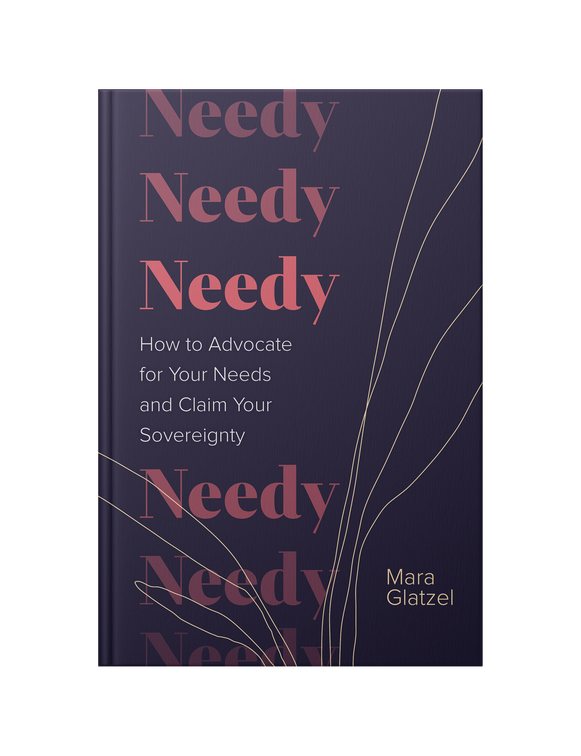
Excerpted from Needy: How to Advocate for Your Needs and Claim Your Sovereignty by Mara Glatzel.

Mara Glatzel, MSW, (she/her) is an intuitive coach, writer, and podcast host. She is a needy human who helps other needy humans stop abandoning themselves and start reclaiming their humanity through embracing their needs and honoring their natural energy cycles. Her superpower is saying what you need to hear when you need to hear it, and she is here to help you believe in yourself as much as she believes in you. Find out more at maraglatzel.com.
Learn More
Amazon | Barnes & Noble | Bookshop | Sounds True

Raw Blueberry Cheesecake
Raw Vegan Blueberry Cheesecake
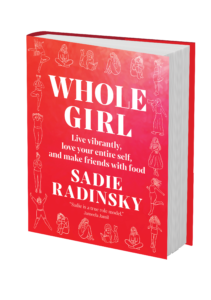
From the book, Whole Girl by Sadie Radinsky
Yield: 8 servings
INGREDIENTS:
CRUST
- 1 ½ cups roasted pecan pieces
- 2 Tbsp monk fruit maple-flavored syrup or pure maple syrup
- 1 Tbsp coconut oil, melted
FILLING
- 2 cups raw cashews or cashew pieces, soaked overnight in 4 cups of water, then rinsed
- 1 cup freeze-dried or fresh blueberries
- ½ cup coconut cream, from the top of a chilled 13 1/2-ounce can of full-fat coconut milk
- 2 Tbsp monk fruit maple-flavored syrup or pure maple syrup
- 2 Tbsp fresh lemon juice
- 2 Tbsp coconut oil, melted
- 1 cup fresh blueberries
INSTRUCTIONS:
CRUST
- Line the bottom of a 6-inch springform cake pan with a circle of parchment paper and set aside.
- In a high-speed blender, blend together the crust ingredients just until it forms a dough-like consistency. It might help to use your blender’s tamper, if you have one. Do not overblend or it will turn into pecan butter!
- Press the pecan crust evenly into the bottom of the cake pan and place in the freezer while you prepare the filling.
FILLING
- Without washing your blender, combine the filling ingredients (except for 1 cup of fresh blueberries) and blend until completely smooth.
- Pour the filling onto the frozen crust and top with 1 cup fresh blueberries. Place in the freezer for approximately 5 hours, or until it’s frozen through.
- Using a butter knife, gently swipe around the inside of the pan to loosen the cake. Remove the cake from the springform pan. Slice and serve. Store any leftover cake in an airtight container in the freezer for up to 1 month. Thaw for 15 minutes before serving.
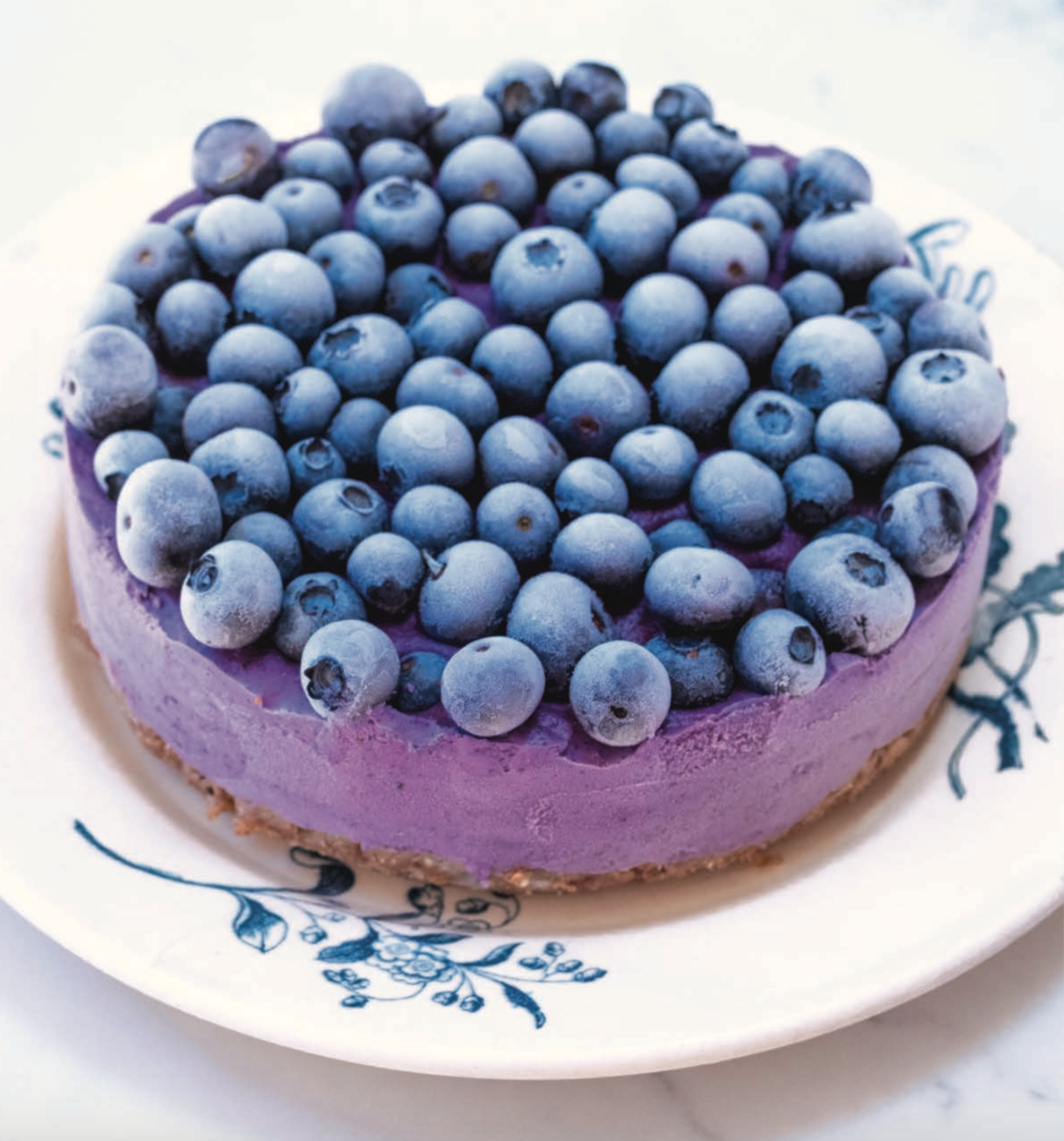
This recipe is featured in the young adult book, Whole Girl: Live Vibrantly, Love Your Entire Self, and Make Friends with Food by Sadie Radinsky.
 Sadie Radinsky is a 19-year-old blogger and recipe creator. For over six years, she has touched the lives of girls and women worldwide with her award-winning website, wholegirl.com, where she shares paleo treat recipes and advice for living an empowered life. She has published articles and recipes in national magazines and other platforms, including Paleo, Shape, Justine, mindbodygreen, and The Primal Kitchen Cookbook. She lives in the mountains of Los Angeles. For more, visit wholegirl.com.
 Sounds True | Amazon | Barnes & Noble | Bookshop | Indiebound
Sounds True Radio
Come on by and take a listen to Sounds True Radio! – http://www.soundstrue.com/radio/
Our free, 24-hour-a-day, streaming radio station offers music for yoga, meditation, relaxation, and inspiration; audio teachings from bestselling and highly respected authors; and insightful and provocative interviews with spiritual teachers and authors on the cutting edge. We also have a new channel which provides selections from many of our new releases. Sounds True Radio is an easy (and free!) way to connect with our authors and to immerse yourself in heart-opening and life-changing wisdom. Through the station, you can also access our our acclaimed Insights at the Edge podcast.
Whether you’re interested in mindfulness, personal growth, emotional healing, awakening and the spiritual journey, creativity, meditation, mantra, sacred chant, brainwave and other healing music, kirtan, or world music of all kinds, you’ll be sure to find something to inspire and open you to the preciousness of the journey that we share together. We look forward to connecting with you at Sounds True Radio soon!

Bedtime Visualization: Rocketing to the Moon

Bedtime should be the calmest moment of the day with our kids, but often it is anything but. Whether we are dealing with last-minute pajama changes, tooth brushing negotiations, or we’re trying to corral our kids into their rooms, it can end up being an exasperating time for both kids and parents alike.
There are many reasons bedtime can be hard. The first is that we are tired, and of course they are too, so no one is exactly ‘at their best’ at the end of the day. Another challenge for children is that they are about to say ‘goodbye’ to us for the night and that can bring up anxiety about being on their own. Also, let’s face it, falling asleep can be difficult regardless of age. The shift from active to rest is not easy; especially when you add a mind full of racing thoughts—which is typical for children (and adults) when things get quiet at night.
What is needed is a way to help children settle mentally and physically at bedtime. When they feel safe and at ease, falling asleep gets a lot easier. Guided visualizations are tools to support children in using their own imaginations to let their bodies and minds relax at bedtime.
The visualizations in Sweet Dreams: Bedtime Visualizations for Kids ,by Mariam Gates and illustrated by Leigh Standley, engage children in mini journeys to underwater worlds, a horseback ride through a field, and even into space while helping them naturally shift into relaxation. The fun and gentle exercises move them into a calm state which is essential for a good night’s rest. Each visualization is also short enough that it can be easily added as a ‘final story.’
We invite you to try the “Rocketing to the Moon” visualization from Sweet Dreams and see if it helps make bedtime a little smoother for everyone.
Lie down on your back and bring your legs together, pressing your arms tight against your body. You are a rocket ship going to the moon.
Start bouncing your legs to ignite the engine.
10 . . . 9 . . . 8 . . . 7 . . . 6 . . .
Now shake, shake, shake your whole body.
5 . . . 4 . . . 3 . . . 2 . . . 1. BLAST OFF!!!
As you launch into space, point your toes and make yourself as long as you can.
Take a DEEP BREATH IN and a LONG BREATH OUT. Relax your whole body as you sail through space. You are heading toward the moon.
All around you are bright stars and clusters of asteroids. It’s peaceful and quiet.
The moon is getting bigger and bigger the closer you get.
Thud. YOU HAVE ARRIVED.
Step out of your rocket. Bend and extend your legs to make big steps onto the moon like you are walking in slow motion.
You can see Earth in the distance. It is blue and green, like a jewel hanging in the dark sky. Take some deep breaths in and out and think about Earth and how beautiful it is. Think about how lucky you are to live on such a wonderful planet.
It’s time to climb back into your rocket ship.
Take another DEEP BREATH IN and a LONG BREATH OUT.
YOU ARE HEADING HOME.

MARIAM GATES has a master’s degree in education from Harvard University and two decades of experience working with children. She is the author of the bestselling Good Night Yoga series. Mariam likes to spend most days writing, where she can explore underwater depths, fly through the sky, and walk on the moon—all in the same afternoon! She lives with her highly imaginative family in Northern California. Learn more at mariamgates.com.

LEIGH STANDLEY is the artist, writer, and owner of Curly Girl Design, Inc. She creates art for greeting cards, calendars, journals, wall art, and more, and her art is sold throughout the U.S. and around the world. Leigh resides in Boston with her husband and twin little people. She can’t live without yoga, her family, Snickers, and Lucy the Wonder Dog. Leigh believes in magic and is quite certain that given a cape and a nice tiara she could save the world. Learn more at curlygirldesign.com.

Available at your favorite bookseller
6 Principles for Befriending Yourself: Part III

Enjoy this third and final installment in our new mini-series of Befriending Yourself, written by Jeff Foster and Matt Licata. Ready to go deeper? Check out their new monthly online community! Get all the details here.
In our previous excerpts (which you can view the first installment here and the second installment here if you missed it!), we discussed the first four principles of befriending yourself:
- STOP TRYING TO BE HAPPY (happiness is not something you can “do”)
- TRUE MEDITATION IS NOT WHAT YOU THINK (it’s what you are)
- “ONE MOMENT AT A TIME” (this one idea could save your life)
- SUFFERING IS OPTIONAL (but sometimes pain and grief are inevitable)
Here are the final two principles on befriending yourself…
5. WORDS ARE MAGIC SPELLS (so cast them wisely!)
We can get so tangled up in concepts and words, especially heavily weighted spiritual and psychological concepts such as “awareness,” “ego,” “integration,” and even “healing.” We forget that words – no matter how subtle and profound – can never, ever capture our first-hand embodied experience. Words always come after the fact. Concepts are general and abstract, and not subtle, nuanced, specific, or concrete enough to match the sheer uniqueness of what you are experiencing in one here-and-now moment.
Does the word “flower,” the idea of it, really capture the sheer inner mystery of a flower? Does the word “anxiety” really begin to capture the sheer LIFE surging through the body in a given moment?
For example, rather than saying to yourself, “I’m anxious,” (or scared or angry or lonely or bored, etc.), as an experiment, try dropping the word, and attuning to the actual lived experience you are encountering in the moment, which will be very unique for you. In other words, come out of the mind and its thoughts and ideas and judgements and stories and negativity about anxiety, and come back to your body in the present moment. Be a beginner. Meet the moment as if you didn’t know anything about anxiety, but wanted to connect with it for the first time. It is this “Beginner’s Mind,” as they say in Zen, that is the wellspring of meditation.
Ask yourself, “How do I know I’m anxious? What is my lived experience of anxiety? Where do I feel what I call “anxiety” most strongly in my body, RIGHT NOW? What is happening in my belly, chest, throat, head, RIGHT NOW? Can I begin to bring attention to the raw sensations in my body, without judging them, without trying to get rid of them, without trying to escape them or make them go away?”
What kind of sensations do you notice? Are they fluttering, pulsating, throbbing? Are they moving fast or slow? Do they feel shallow or deep in the body? Are they warm or cold? Are they intense or gentle? Are they moving in straight lines, circles, zig-zags? Are they sharp or dull? How far under the skin are they? Do they change when you bring awareness to them? Do they become more intense? Less intense? Do they expand or contract? Do they start moving around in the body?
Can you become curious about all this life in your body, without trying to fix or change it? Feel or imagine your breath moving into the sensations, so you are bringing the warmth of your presence and the gentleness of your breath to this contracted, aching, sore place. Perhaps this is just a part of your body that is starved of attention and oxygen. Breathe into that place that feels tight, contracted, bound-up. This is an act of love.
Say to yourself, “These are just sensations. They are just the intelligence of the body. They are not dangerous. They are just LIFE. They are not hurting me. They are not working against me. They are not a mistake. They are not a sign that there is something wrong in this moment, or that I have failed in some way. They are just parts of me longing for love and kindness. They are the abandoned parts, the parts I need to take care of right now..”.
Scientific research over the last couple of decades in the area of mindfulness and self-compassion suggests that courageously bringing curious, accepting, non-judgemental present-moment attention to sensations in our body, even if they are intense and uncomfortable (and therefore “unwanted”), can soothe our nervous system’s more urgent fight-or-flight response and help us to access the slower, empathic circuitry of the prefrontal cortex. Slowly, over time, we can build tolerance for difficult experience, come to discover its ultimate workability, and eventually use our hooks, triggers, and activations as invitations into deeper holding and compassion for ourselves and others. We can come to realise that feelings and sensations in our bodies are ultimately safe, even if they feel unsafe.
What is happening inside you is unique, unprecedented, vast, and majestic, and will never be captured by experience-distant concept words like “unworthy,” “anxious,” or “ashamed,” which – if you think about it – are all other people’s words, given to you when you were young, or by the medical community, or by a culture who has fallen out of touch with the wisdom of raw experience. There is a world before words, before the mind itself. And in that world, you may find the peace and wholeness you seek.
Even if the intensity of sensation does not diminish with our kind and curious attention, that intensity begins to occur in a much vaster space, in a larger context, one that is warmer, more open, and safer than we imagined. Instead of being caught up inside a feeling or mood or bundle of sensations, we recognise that these energies are actually caught up in us. We are actually bigger than any thought, sensation or feeling. We can begin to hold our fear and boredom and sorrow, so they don’t hold us. We are not the victims of our anger and confusion, we are the space for them, the vast open sky in which they can come and go. Some call this space Awareness, but we could also call it Love. Or Who You Really Are.
6 THE SECRET OF “HOLDING, NOT HEALING” (“negativity” as a call for love)
Imagine or visualise a difficult thought, feeling, urge, or emotion as a child knocking at your door. Allow your challenging present experience to take form, imaginatively, as a young child (or other figure) that you can enter into a relationship with.
If you are feeling sad, for example, imagine a sad child arriving at your door and knocking, wanting to come in. Perhaps they are cold, confused, shaking, and exhausted from a long journey. They have not come to harm you in any way, but just to be held, to be allowed back home, into the warmth of your heart. Once inside, we can sit with them and have a conversation: Why have you come? What do you need? What do you want to show me? We can listen to the wisdom they have to share, and help them to release any burden they have had to carry on our behalf.
How would you respond to this frightened little one when you opened the door?
Would you slam the door in his or her face and distract yourself with TV or food (or even spiritual beliefs and practices) and try to forget them? Would you lock the door? Would you look sternly at them and state that they are welcome to come in… once they have changed? Once the sadness has been transformed to joy, the anxiety to calm, the uncertainty to clear-knowing… ah, then yes you can enter?
Or would you allow this one in to the living room of your own heart, Now, where you can listen and tend to them with curious, loving awareness? Would you open your arms wide to them, and let them come home?
It can be helpful to turn a difficult thought, feeling, memory, urge, or impulse into a figure with which you can dialogue or have a conversation. Doing so allows us to open our hearts to our pain, our emotions, and our experience rather than relate to it merely conceptually or from a distance. It’s not easy or natural to cultivate a caring, interested, warm relationship with a concept, such as “grief,” “shame,” or “rage.” But to meet a grieving child, or figure who is ashamed or enraged, we can more naturally move closer to them, listen to them, open a dialogue with them, and bring movement into our experience where maybe it had become stuck. Rather than becoming flooded or swallowed up by this energy, imaginatively allow it to form in front of you where you can ask it why it has come, what it needs to show you, what it wants. This is how you can begin to reclaim your power in the face of a scary, uncomfortable, unknown, or difficult energy. See it as a lost and helpless and forgotten part of you, looking for your help, seeking love, not an enemy or a dangerous force from outside of you.
“Befriending” is not as much about “healing” as it is “holding.” In true befriending, we do not have a heavy agenda to change, shift, fix, cure, transform, or, surprisingly, even “heal” this energy. From this perspective, we are never “unhealed” or “untransformed”, really. We are not a project to be improved, but a mystery coming into form, moment by moment. We are always whole, even in moments of intensity and discomfort. We were never not whole (healed).
By “holding” our experience in any moment instead of rushing to try and fix it or run from it, we are inviting relationship with the present “visitors” – the thoughts, feelings, images, and impulses – that have come in a moment of activation, without falling into the extremes of either denying or repressing them on one hand, or becoming fused with or flooded by them on the other. We disentangle a bit from them so that we can enter into loving relationship. We can practice a certain kind of intimacy with them, but without fusing or identifying, or drowning in thoughts, feelings, and sensations. We can dialogue with them and even have boundaries with them, letting them know of our intention to move toward them, but only in a way and at a pace that works for us. We can take back our power from the ‘dark’ material within.
In our own unique ways, through experimentation and curiosity, we discover a sacred middle place between repressing a thought or feeling, or habitually and unconsciously expressing it or acting it out. In this middle place, this third possibility, we slow down, and breathe, and infuse the visitor with curiosity and loving breath:
“I am here to meet with you, to hold you, to listen to you, to care for you. But not to be flooded or fused with you. Let us be true friends. I trust that you are just a part of me, needing love. I want to get to know you, moment by moment. This is a beginning, not an end…”
Remember this image of holding in moments of activation and overwhelm, in both its personal and transpersonal dimensions. We can hold ourselves and parts of ourselves when we are triggered and hurting, but we can also relax into a kind of Sacred Holding that is always, already happening through something greater than us. We are holding and we are already being held – by the Earth, by the sky and the mountains and forests and oceans, by the Universe itself, by the Loving Mystery that is every living thing.
Even in the moments we feel we cannot “hold” ourselves, we are already being held by Life. Even in the moments the present moment feels “unbearable,” Life is bearing us. This is the true definition of surrender. It is not something we can understand with the mind.
Ultimately we do not “do” healing. Healing is “done” to us in the moment where we stop struggling against life and our own thoughts and feelings and relax into the Mystery.
As we let go of the inner war with our experience, soften into this instant of life and open our heart and being to what’s here – even if what’s here is uncomfortable, raw, scary, and intense – we are no longer victims of the moment, but become the infinite and victorious Power that allows the moment to be, the Calm in the midst of life’s storm.
Our power lies not in refusing the moment, but softening into it. There is strength in our vulnerability, power in our willingness to open our arms to whatever the moment brings.
Thank you for reading this series on the mysterious dance of being and befriending! Our words are intended as “fingers pointing to the moon,” as they say in Zen. You will find your own way into the vastness and sheer mystery of your experience. May you honor your wildness, your individuality and eccentricity, as you take your own unique journey to the Home you never left. We hope these words have helped point you in the right direction… one that leads back to YOU.
As Rumi reminds us…
“There are hundreds of ways
to kneel and kiss the ground.”
We hope you enjoyed our new mini-series of Befriending Yourself, written by Jeff Foster and Matt Licata.Ready to go deeper? Check out their new monthly online community! Get all the details here.
ABOUT THE AUTHORS
JOIN JEFF FOSTER AND MATT LICATA EACH MONTH IN THEIR NEW “BEFRIENDING YOURSELF” MEMBERSHIP SITE: www.befriendingyourself.com

MATT LICATA
Matt Licata, PhD is a psychotherapist, writer, and independent researcher based in Boulder, Colorado. Over the last 25 years, he has been active in the ongoing dialogue between depth psychological and meditative approaches to emotional healing and spiritual transformation.
His psychotherapy and spiritual counseling practice has specialized in working with yogis, meditators, and seekers of all sorts who have come to a dead-end in their spiritual practice or therapy and are longing for a more embodied, creative, imaginative way to participate in their experience, in relationship with others, and in the sacred world.
Matt’s spiritual path and exploration has been interfaith in nature and includes three decades of study and practice in Vajrayana Buddhism, Sufism, Daoism, and Contemplative Christianity. His psychological training and influences have been in the larger field of relational psychoanalysis, Jung’s analytical and alchemical work, and Hillman’s archetypal psychology, to name a few. He is the editor of A Healing Space blog and author of The Path is Everywhere: Uncovering the Jewels Hidden Within You (Wandering Yogi Press, 2017) and the forthcoming A Healing Space: Befriending Yourself in Difficult Times (Sounds True, 2020). His website is www.mattlicataphd.com
JEFF FOSTER
Jeff Foster studied Astrophysics at Cambridge University. In his mid-twenties, struggling with chronic shame and suicidal depression, he became addicted to the idea of “spiritual enlightenment” and began a near-obsessive spiritual quest for the ultimate truth of existence. The search came crashing down one day, unexpectedly, with the clear recognition of the non-dual nature of everything and the discovery of the “extraordinary in the ordinary.” Jeff fell in love with the simple present moment, and was given a deep understanding of the root illusion behind all human suffering and seeking.
For over a decade Jeff has been traveling the world offering meetings and retreats, inviting people into a place of radical self-acceptance and “Deep Rest.” He has published several books in over fifteen languages. His latest book is The Joy of True Meditation: Words of Encouragement for Tired Minds and Wild Hearts (New Sarum Press, 2019). His website is www.lifewithoutacentre.com