Human communication, even on a good day, is really terrible. It really is. We misunderstand each other much of the time.
Do you really know whether your partner understands what you are saying? Does your partner get the nuances or understand the purpose of the words you are using? Do you think they know exactly how you feel about your words or the meaning of the words? When you’re listening to someone, do you think you really understand them? Do you understand their mind? Their context? More often than not, you are approximating each other. You’re getting close.
Most of our communication is implicit, nonverbal. Our verbal communication, which we all love and adore and depend on, is really the culprit. It gets us into a lot of trouble.
When you were dating, I’m sure you were much more careful about the words you used. How careful are you now? Many couples grow sloppy with each other in terms of their verbal communication. They take shortcuts because they think they know each other.
You’re probably taking a lot of shortcuts, assuming your partner understands the meaning of your words, and you’re getting into trouble. Do you even have each other’s attention when you are communicating? Many times, you don’t. You both are busy, you are moving, and your lives are only getting busier. And then you find yourselves saying, as many couples do, “Oh, it’s my partner’s problem. They’re not listening.” Right?
When it comes to communication, you both must take responsibility for making sure that your speech is clear and understood by the other person. As you will read in this section, just because you say something, doesn’t mean your partner is translating it as you intend.
Here’s an example:
Partner A: I want more intimacy in our relationship.
Partner B: I want that, too!
The problem here is that to Partner A intimacy means “more sex.” Partner B, on the other hand, thinks that agreeing to intimacy will mean more interpersonal talk. What is more is that sex actually means “only intercourse,” and interpersonal talk specifically means “more questions about how I’m doing.” That is how we talk to each other—as if the other person knows exactly what we mean. Much of the time, we don’t even know exactly what we mean.
Remember the good old days (of course you don’t) when speech was simpler? We would just say, “Duck!” or “Eat!” or “Sleep!” or “Run!” or “Lion!” Fast forward to today’s linguistic complexities and consider for a moment all the nuances in our talk, all the lingo, all the changing meanings for regular words. Take the word sick, for example. Today it could mean physically ill, mentally ill, disgusting, or amazing. And the language couples use with each other can seem even more confusing. “I want to know you deeply” could mean many different things. “I want you to show me your soul” could make a person’s head spin. “I want you to say what you really feel” can, for some, seem like a trick or an insurmountable task. We use a great many words and phrases that mean a great many things, none of which partners clarify with each other. This is a terrific error.
The human brain is always trying to conserve energy; it does as little as possible until it must. Most people, particularly partners, will treat clarification as unnecessary and, in fact, frustrating. “You should know what I mean,” a partner might say. “My meaning is obvious.” Or, “Everyone knows what that means.” Both speaker and listener feel persecuted by the chasm between meaning and understanding. Minds misattune, which leads to heightened arousal (faster heartbeat, higher blood pressure), which leads to threat perception, which leads to fight, flight, or freeze.
Rinse and repeat.
Check and Recheck This common and frankly annoying error is easily avoidable by returning to the formality likely present at the beginning of the relationship. Check in with simple, nonthreatening questions or requests:
“Are you saying . . . ?”
“I want your eyes because this is important . . .”
“Let me make sure I understand . . .”
“Say back what you heard . . .”
“Let me repeat that.”
“What do you think I meant by . . . ?”
“We may not be talking about the same thing. Are you saying . . . ?”
Checking and rechecking is vital to daily governance and the proper running of a two-person system. If you were two astronauts communicating out in space while tethered to the mothership, would you be incredibly careful with your communication? You bet you would. Your lives would be at stake. If you were two generals deciding a war plan, would you talk in shorthand or assume you were on the same page? If you did, people would die. You are no different. If you and your partner continue to use shoddy communication to share information, your relationship will suffer badly.
These errors, if repeated again and again, go right into your respective personal narratives about what’s wrong with the other partner and why you’re unhappy. Remember, our personal narratives form to protect our interests only and are almost always based on faulty data—like errors in communication!
Be orderly. Be precise. Be responsible. Be a two-person system.
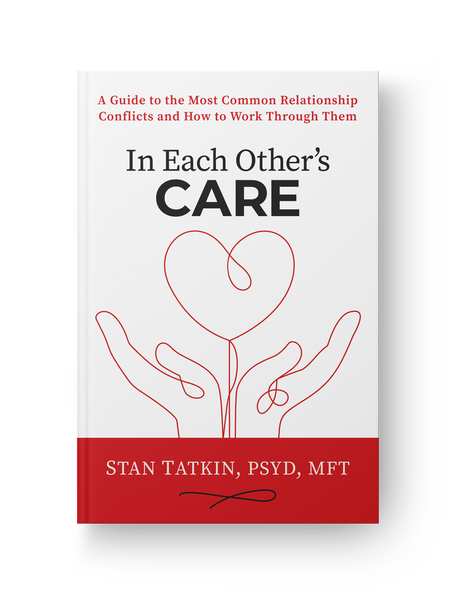
This excerpt is adapted from In Each Other’s Care: A Guide to the Most Common Relationship Conflicts and How to Work Through Them by Stan Taktin, PsyD, MFT.
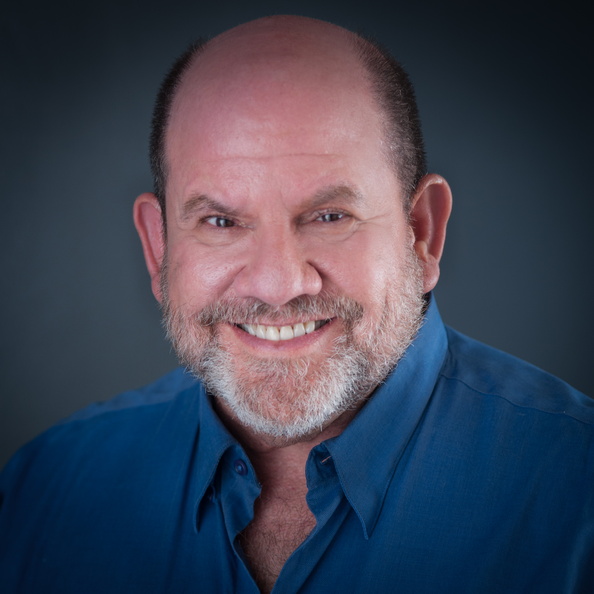
Stan Tatkin, PsyD, MFT, is a clinician, researcher, teacher, and developer of A Psychobiological Approach to Couple Therapy® (PACT). He has a clinical practice in Calabasas, California, and with his wife, Dr. Tracey Tatkin, cofounded the PACT Institute for the purpose of training other psychotherapists to use this method in their clinical practices. For more information, visit thepactinstitute.com.
A doctor of Chinese medicine who was a famous bonesetter in China once said to me with a heavy accent, “Here, you [meaning Americans] don’t like to feel pain. You don’t like to suffer.” He said this as he wrung my neck as one would a chicken’s, snapping it back and forth in a way I had never experienced. I screamed as if he were breaking my bones.
For a month prior, I hadn’t been able to move my head to the left or right. My left arm was nearly immobile. I had just started a new job that probably should have ended the moment my body locked up. I went for acupuncture, then pain pills; used ice and hot water bottles. I went to medical doctors, and they X-rayed the area and gave me more pills and a brace to keep my head still—the kind used for whiplash. I later tried one of the best chiropractors in the city, and she gave me the number of a neurosurgeon, thinking I had a herniated disk and would need surgery. I did not seek out the surgeon and stayed in pain for weeks. Finally, a friend from my job gave me the number of her doctor, the famous bonesetter mentioned above. I called him at 10:00 pm that night. That’s how much pain I was in. To my surprise, he answered the phone. He said, “Come in. I wait for you.”
I said, “Now?”
“Yes!” he said. “You have pain, come now.”
Wow, I thought. Now that’s a healer. It didn’t matter that it was the middle of the night.
My partner at the time drove me across the Bay Bridge to San Francisco, and I met my friend from work at the healer’s office. She had come to translate from Mandarin to English. The place was tiny, with photos on the wall of city dignitaries and other famous people who were his clients.
“Hi.” The bonesetter smiled like a boy. “I’m Dr. Fu.”
I sat down in his small room and showed him my X-ray. He threw it on the floor without looking at it. He took the brace off my neck and threw that on the floor, too, right next to the X-ray. Then he twisted me into a pretzel. I howled, yelped, screamed, and hollered.
All of it. No wonder he had me come when no other patients were there. He told me to breathe, and I did my best. Suddenly, at the peak of the pain, I felt my muscles release in my neck, shoulders, and back. It was in fact a miracle to me. I had suffered so long.
I carried my brace and X-ray out in my hands. It was as if I had never been in pain or unable to move. The night sky filled with stars made me feel like I was on another planet. I was in bliss. When I returned to work, everyone was shocked. Was it a miracle, or was it the ability to withstand a greater amount pain to be free of the pain? I would have never imagined that I needed to go deeper into the pain, deeper into the darkness of it. All I had wanted was out.
We are averse to pain and suffering and understandably so, given our American sensibility. We have access to a large market of remedies, products, spiritual paths, and, yes, gateways to the freedom from suffering. I wonder how many times we have diverted our own freedom when we have discovered there is more pain, more trouble, more darkness ahead and we keep adding on remedies. What is the mindset, along with fear and terror, that causes us to avoid our suffering rather than go deeper into seeing what is there? Yes, I should have quit that job on the spot when the pain started, even though I had been there for only a few weeks. I didn’t know at the time, but the pain that was deep inside was because I wanted something different for my life than the job I had accepted. The pain was my impatience, and it was at the same time physical pain in real time. I didn’t wait to allow that“something different” to be revealed in the darkness.
Since all paths—religious, spiritual, or without name—intersect in the place of darkness, darkness is the place where the mind is forced to detach itself from whatever it has grabbed onto in life. And in that nothingness, in that dark place, we awaken.
What of darkness terrorizes us so that we run from it, rather than go deeper into it? How can we bear dark times, or, more explicitly, horrifying times, with the skill of an awakened one? Misery, struggle, and sorrow are not the sole intentions of this life. Yet we can respect our interrelationship with everything in the world, including the suffering in, around, and between us. Is there a way to live in unsettling times that we have forgotten?
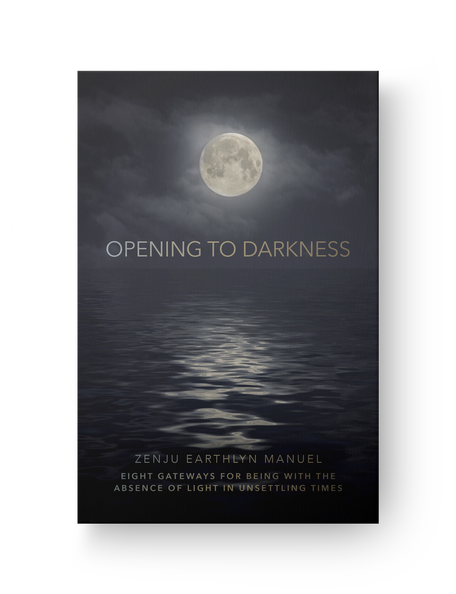
Excerpted from Opening to Darkness: Eight Gateways for Being with the Absence of Light in Unsettling Times by Zenju Earthlyn Manuel.
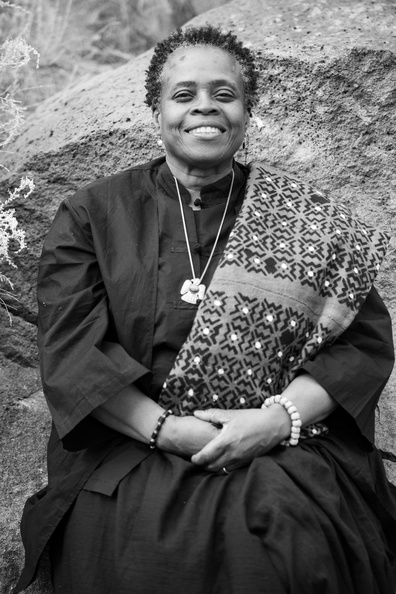
Osho Zenju Earthlyn Manuel, PhD, is an author, poet, ordained Zen Buddhist priest, teacher, and artist, whose diverse background, education, and experience all provide a unique integral and cultural perspective within the space of religion and spirituality. She is the author of The Shamanic Bones of Zen, The Way of Tenderness, The Deepest Peace, and more. Manuel is a native of California and now resides in New Mexico. Learn more at zenju.org.