

The Sacred Art Of Taking A Bath

When I tell my students that one of the most magical things they can do is take a bath, I rarely have to say anything more, for we intuitively know that the time we take to shower and bathe is time touched by wild magic, and the space in which we do so is space imbued with the scent of the sacred.
Make Your Bath Sacred
Consider your own bathing rituals right here and right now. Begin with the fundamental question, “What needs to be washed away, removed, released?” And then, “What kind of bathing appeals to you the most?” A brisk shower or a slow bath? If you use products like bubbles, soap, bath salts, or body scrubs, why did you select them? Do you love to bathe in the privacy of your own home, or do you feel most connected to your remembered magic when you immerse yourself into a wildly running river, the cresting waves of a great ocean, or the green depths of a limestone spring? What elements need to be in place to change your bathing experience from one that is merely practical and about physically cleaning yourself to one that is also extraordinary and capable of washing away deeper marks and struggles?
Where do you feel dry?
Just as the land where we live contains water, our soul soil also holds swift rivers, vast oceans, and deep springs. These interior waters are the places understood to hold the human capacity for deep feeling and emotion, creativity, love and compassion, vitality and nourishment. And just like bodies of water in the surrounding world, our interior waters can be dammed up, walled off, covered over, and blocked in a variety of ways. These waters can also be polluted. Sometimes this is done by others or is a result of the toxic aspects of the culture at large, and sometimes we do it to ourselves without realizing it. Having set up house in multiple arid lands, I can tell you from firsthand experience that the presence or the absence water in our surrounding world presses us to ask hard questions about our internal waters. Consider where your life feels dry, uninspired, lacking creativity, fecundity, and fertility? Where are the places that have become too tough and hard and not nearly tender enough? Where has your soul soil been in drought for year upon year, so that all you can find there is dry dust and cracks in the ground? Where is the spark of life lacking or completely absent?
Where do you feel in the flow?
After considering what makes you feel dried up and devitalized, consider the opposite. What calls up your life and creativity? What makes you feel like your inner landscape is well irrigated and flowing with wide rivers or caressed by ocean waves? What are the ways that you best clean up the hurt places in your life? What are the medicines that help you heal most readily and completely? Our work here calls us to an awareness of the places that feel broken, the parts of life and the stories, beliefs, and habits that devitalize us from the inside out. Working with water in an intentional manner can also highlight these places, for we become acutely aware of where precisely there is lack. It is natural to feel that there is not enough water in the whole world to slake the deepest soul thirst and soothe the most parched places of our hearts. It is true: there is not enough water in the world to quench that thirst. But there is enough water in each of us. When you live in a desert, as I have for most of my life, you come to know this as fact. There is good water, strong and flowing, usually many miles beneath the surface, and when the thunderclouds come in and the wind begins to blow just so, the sheer rocks themselves begin to usher forth rivers and streams, and the well that springs up from the deepest self carries on its waves life-bestowing and life-affirming blessings.
Don’t have time for a full sacred bath every day? Try these stepping stones instead!
Make moon water. Fill up a clear glass jar with water and leave the top of it open. Set it outside under a full moon. Drink it down the next morning and note the texture, taste, and feel of the water as you do. Notice too how your body feels after drinking it.
Create a sacred spray. Get a spray bottle, fill it with water, add a few drops of your favorite essential oils, and use this quick version of sacred water to spritz yourself and your home, as you like.
Give yourself a footbath. Fill a basin with warm water, and add a teaspoon of baking soda, some lemon and lime slices, and any essential oils you like. After soaking your feet, pick out an oil or lotion to anoint your feet. Cleansing and anointing the feet is an ancient practice that honors one of the most sensitive (and taken for granted) parts of our bodies.
This is an excerpt from Making Magic: Weaving Together the Everyday and the Extraordinary by Briana Henderson Saussy.
Download a free Making Magic journal here.

Briana Saussy is a teacher, spiritual counselor, and founder of the Sacred Arts Academy, where she teaches tarot, ceremony, alchemy, and other sacred arts for everyday life. She lives in San Antonio, Texas. For more, visit brianasaussy.com.
Buy your copy of Making Magic at your favorite bookseller!
Sounds True | Amazon | Barnes & Noble | Indiebound



Five Tips for Postpartum Bliss
Bliss out on baby, mi amor. Love your chichis. Admire your soft curves, your delicate belly, and the way you require intentional care. Everything deep comes to the surface as you pour sweat, milk, blood, and tears onto your sheets. I want your postpartum to feel blissful, so here are five tips to help you make that happen.
1. Make a postpartum plan.
You can’t plan exactly the way the birth will pan out, but you can plan the details of your postpartum support. Bodywork, meals, laundry, and childcare for your other children are some things to consider. Use this book as a guide to feel into what nonnegotiables you’ll need in place during la cuarentena.
2. Don’t DIY postpartum.
There’s a time and place for self-reliance. Postpartum ain’t the time. Postpartum traditions are community centered. Once you know that you’re pregnant, surrender to other folks holding you. Waddle that ass to circles with like-minded familias who you know would be down for mutual support. This is why we have the Indigemama community and so many other comunidades who are dedicated to saving our lives.
3. Shift your mindset.
One of the biggest internal challenges I see postpartum people go through is the mental chatter that puts a wall up, barring any chance for outside support. When we’re socialized into struggling and then rewarded for doing things on our own, it’s easy to feel guilty asking for help. You might be distrustful of other people’s capacity to fulfill your needs. How many times have you heard women say, “If you want something done right, you gotta do it yourself”? This belief sets postpartum people up for anxiety, stress, depression, and overwhelm. If you want postpartum done right, you have to feel in your body that you are worthy of being venerated; you must feel that you are deserving of being held.
Paying homage to you is paying homage to nature itself. Give your potential supporters that opportunity to connect with creation.
4. Repeat after me: affirmations, affirmations.
It’s easy to feel ashamed to ask for what you need. It’s normal to feel guilty when you see how hard people are working for you. Give yourself a pep talk: I allow myself to be cared for. I accept this help. I trust that I can be held without lifting a finger. I surrender myself to the love and labor of others. I soften and allow myself to be carried. I want you to do this every moment that you need it. When you affirm that you’re doing the right thing over and over, then eventually it becomes second nature.
5. Support your romantic relationship.
Postpartum is stressful AF! Those of us with multiple children can tell you that the little ones tend to take precedent over romantic relationships. But after a while, that really weighs down a union. Plan relationship goals. When will you start to date again? What’s the plan for one-on-one time? Who are the people who hold you and your partner(s) up as a sacred union? What baggage can you each decide to let go of now? What support can each of you get individually from healthy older couples who are content with each other? What can you appreciate about each other during la cuarentena? What words do you need to say to each other when the going gets tough? Nurturing a healthy, loving relationship with each other when you’re parenting children is a practice of discipline.
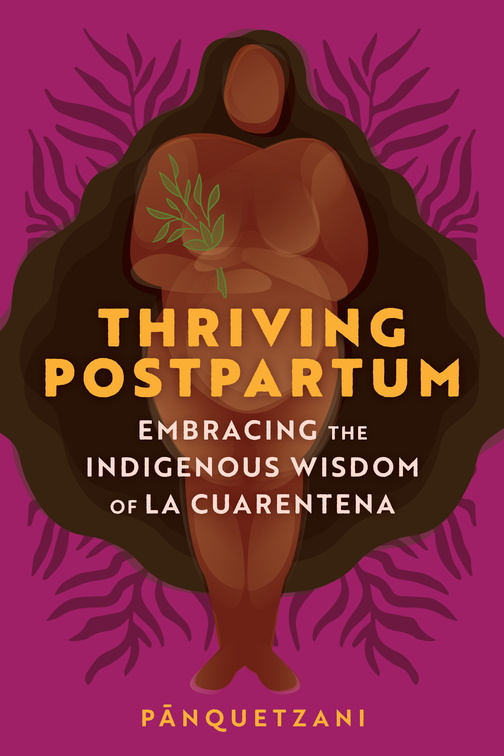
This excerpt is from Thriving Postpartum: Embracing the Indigenous Wisdom of La Cuarentena by Pānquetzani

Pānquetzani
Pānquetzani comes from a matriarchal family of folk healers from the valley of Mexico (Tenochtitlan, Texcoco, and Tlaxcala), La Comarca Lagunera (Durango and Coahuila), and Zacatecas. As a traditional herbalist, healer, and birth keeper, Pānquetzani has touched over 3,000 wombs and bellies. Through her platform, Indigemama: Ancestral Healing, she has taught over 100 live, in-person intensives and trainings on womb wellness. She lives in California. For more, visit indigemama.com.
Learn More
Amazon | Barnes & Noble | Bookshop | Sounds True
How to Cultivate Generosity in Our Children

Nearly every spiritual tradition has a practice of generosity and giving. We call it Dana in some traditions, Caritas in Christianity, Tzedekah in Judaism, alms or communal sharing in others, or in the United States, “The Holiday Season” stretching onward from Black Friday through the New Year. These spiritual (and commercial) practices existed long before the term “positive psychology,” but the principles overlap significantly. We know now that making a practice of kindness and generosity leads to physical and mental health and social and spiritual benefits.
In families, children are often in the “getting” role, while adults are in the “giving role,” but how can we encourage that spirit of generosity in the next generation?
We are wired to be generous, and both neuroscience and well-worn clichés tells us we feel more joy in giving than in receiving. However, our consumer culture tells us the opposite, that getting will make us feel better. These messages run counter to the spiritual and scientific wisdom showing health and happiness come more through giving than getting. Just imagine if our society received just as many messages urging us to give than get, if people camped outside stores for days just to donate to the latest charity.
Among the many benefits, generosity also builds trust between people. Studies show that the giver’s brain regions associated with trust and connection light up, fostering optimism, reducing depression, and creating healthy attachments, showing us why cultures develop practices related to gift-giving. The benefits even extend to just witnessing an act of generosity.
So how can we encourage generosity our families? Here are a few ideas to consider.
- Involve your kids in the decision for charitable giving, taking into account what your family’s values are: Social justice, the environment, health issues that have impacted your family, presents for children or families in need, and so on.
- Follow the lead of my friend’s grandmother who gave the grandkids $100 each year, with $50 to spend on themselves and $50 she would donate to a charity of their choice.
- Remember that giving can also include your time or your support. Volunteer as a family, a practice shown to boost happiness, empathy, and build closeness.
- Give experiences; the happiness will last longer than the lifespan of a toy. Perhaps travel, theater tickets, or museum passes.
- Donate toys to make space for the new. Notice together which toys are getting lonely and would be happier in a new home, saying thank you and goodbye to old toys, and imagining the happiness they will bring after they’ve been donated.
Looking for more great reads?


Excerpted from Raising Resilience by Christopher Willard, Pysd.
 Christopher Willard, Psyd, is a clinical psychologist and consultant specializing in bringing mindfulness into education and psychotherapy. He lives in Cambridge, Massachusetts, teaches at Harvard Medical Schools, and leads workshops worldwide. For more, visit drchristopherwillard.com.
The Psychology of the Awakened Heart – an online video training with Jack Kornfield
Friends, we’re happy to let you know of a new online video training with our dear friend Jack Kornfield, on The Psychology of the Awakened Heart: A Training in the Four Essentials of a Healthy and Joyful Life. The course will be made available starting October 1st, however you can sign up and join at anytime, working through the material at your own pace, from the comfort of your own home.
The meditation practices passed down from the Buddha are beautiful, time-tested ways to awaken a compassionate, joyful, and loving heart. Buddhist psychology and research from modern neuroscience both show enormous benefits from using these methods as a regular practice or in conjunction with conventional therapy. With The Psychology of the Awakened Heart, master teacher Jack Kornfield invites mental health professionals and meditators alike to an eight-session online video course on the Buddhist psychology of well-being. Each session, Jack will present life-changing practices, wisdom teachings, and healing stories—offering a rich mix of practical and scientific information and experiential exercises based on the timeless principles of Buddhist psychology.
Learn more about this special online training opportunity, watch a video sample, and register here.

Share Good Karma! – free gifts from Sounds True
Dear friends, we wanted to let you know about a new program at Sounds True, called Share Good Karma, which was created so that you could receive free gifts from us – and share them with your friends.
The first two titles featured in the program are a collection of relaxing and healing music, entitled Meditation Music: An Invitation to Still the Mind and Open the Heart; and The Practice of Mindfulness: 6 Guided Practices. Once three of your friends ‘accept’ these free gifts from you, you’ll receive an additional free gift of your choice.
Learn more and get signed up for Share Good Karma!

A Guided Standing Meditation to Activate Your Creative Imagination

Springtime in the heart of May is a time of renewal and discovery, a time of reminding, reconnecting, and remembering our true imaginative potential. Mother may I? Yes, you May. Express your full imaginative self, just as the flowers, fourth graders, and fully feathered birds do.
You are your imagination. It’s not something outside of you that you read in the pages of some book, or something you overhear in the next booth over at Bubba’s Drive-In, or even the memory of your adventures trekking across Nepal (although these are all terrific things to write about). It’s found within you — your imaginative heart and soul, looking like a nebula of stars throbbing in your bloodstream a thousand times a second, at this very moment. Here’s a way to practice conjuring up (imagining) and letting go: the standing “skeleton scan” meditation.
Skeleton Scan Meditation
- Find a quiet place in your house with a soft and comfortable surface to stand on. Close your eyes and take a deep breath inward.
- Ground yourself in this moment, in your body. After the first deep breath, let your breathing become natural.
- Now lightly bring a thread of your awareness to your feet and breathe into your feet. Feel the stability and grounding of your breath at your feet. Now, with your mind’s eye, see the little toe bones of your feet, then follow your imagining to the main parts of your feet and to where they meet your ankle bones.
- Continue up your legs to view the bones joining to your knees then up to your hip bones.
- See your hip bones where they connect to your sacrum and your spine. Now visualize your vertebrae climbing and then branching out into your rib cage. See the ribs of your body wrapping around you and joining at your sternum, protecting your heart.
- Notice now the bones of your shoulders holding your arms, and see those bones of your upper arms, into your elbows, and down to your hands and finger bones.
- Now bring your visualization back up your arms, past your elbows, back up to your shoulders, and see now your neck and where your spine connects to your skull.
- See your skull, the round smoothness of the bone with hollow sockets for your eyes and nose, and see the bones of your jaw and teeth.
- Breathe into this visualized experience of your skeleton. Breathe in and feel your body
swaying gently, knowing right now that this skeleton is your stability and ground—these mineral bones are your conduit to earth and sky. - Take a deep breath inward, exhale, and open your eyes.

 ALBERT FLYNN DESILVER is an internationally published poet, memoirist, novelist, speaker, and workshop leader. He has published several books of poetry, his memoir Beamish Boy (Owl Press, 2012), and his new book Writing as a Path to Awakening (Sounds True, 2017). He teaches at the Omega Institute, Esalen, Spirit Rock, and writing conferences nationally. He lives in Northern California. For more, visit albertflynndesilver.com.
Buy your copy of Writing as a Path to Awakening: A Year to Becoming an Excellent Writer and Living an Awakened Life at Sounds True or your favorite bookseller.