Search results for:

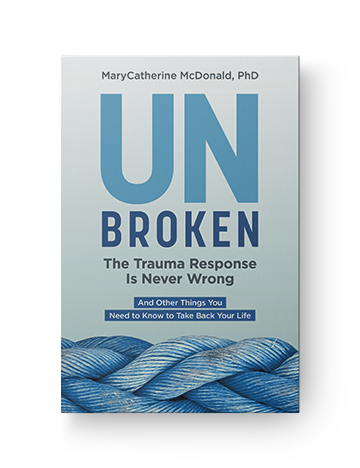
The Trauma Response is Never Wrong

We have been tricked to believe that the trauma response is a sign of weakness and disorder. What science shows us is that the trauma response is in fact a sign of strength and proof of an inherent human drive to survive. We need society to catch up with science, and fast. We are no longer living in an era where we can assume that trauma impacts a minority of the population. Trauma impacts us all. This has always been true, but we can no longer pretend otherwise.

Unbroken is a book about the miracle of the trauma response, the importance of acceptance and self-compassion, and the transformative healing potential that lies within us all. Drawing on my experience as a trauma researcher, coach, as well as my own personal journey of healing, this book offers a new perspective on trauma that emphasizes the wisdom of the body and the resilience of the human spirit.

If you’re struggling with the after-effects of trauma, Unbroken can help you understand your experience in a new light. You’ll learn how trauma impacts the brain, the body, and the spirit, and how you can use this knowledge to start your journey of healing. You’ll discover practical tools and strategies for managing trauma triggers, regulating your emotions, and cultivating self-compassion. Most importantly, you’ll learn that the trauma response is never wrong – it’s a natural and adaptive response to a difficult situation.

One of the most important lessons of Unbroken is that the trauma response is never wrong. This means that even if you’re struggling with symptoms like anxiety, depression, or dissociation, your body is doing exactly what it needs to do to protect you. By embracing this truth, you can start to shift from a place of shame and self-blame to a place of self-compassion and empowerment. The book is chock full of tools that will help you understand and appreciate your trauma response and how to intervene when that response is tripped off unnecessarily. I can’t wait for you to dig in and I can’t wait to hear how this book changes you. It certainly changed me.

MaryCatherine McDonald, PhD, is a research professor and life coach who specializes in the psychology and philosophy of trauma. She has been researching, lecturing, and publishing on the neuroscience, psychology, and lived experience of trauma since the beginning of her PhD in 2009. She’s published two academic books and many research papers, and she is the creator of a trauma-based curriculum designed to serve previously incarcerated folks and veterans
How Reframing Conflicts Can Actually Help Your Relationship

In the Internal Family Systems model, the practice of speaking for, rather than from, parts when they are triggered is an important aspect of Self-leadership. When people receive a message from you, it has two components: the content (the actual words) and the energy behind the words. When your protective parts are upset and speak directly to another person, invariably they will trigger parts in the other. When, on the other hand, you listen to your protectors and then speak for them, from your Self, the message is received in a very different way, even if you use the same words that your parts are saying. Your words lose their judgmental sting or their off-putting desperation and coerciveness. Instead, your respect and compassion for the other person will be heard in addition to the courage of your convictions.

Self energy has a soothing effect on any parts it touches, whether they are in you or in another person. When your parts trust that you will speak for them, they feel less driven to take over and explode at people. What they really want is to have a voice—to be listened to by you and to have their position represented to others.

Practice: SELF-LEADERSHIP AS A WAY OF INTERACTING IN A CONFLICT

These practices—remaining the “I” in the storm or the empty vessel, and speaking for rather than from your parts—can be combined into a general way of relating as a couple when you have conflict. When you begin to fight, each of you can try the following:

  1. Pause
  2. Focus inside and find the parts that are triggered
  3. Ask those parts to relax and let you speak for them
  4. Tell your partner about what you found inside (speak for your parts), and
  5. Listen to your partner from your open-hearted Self

When a couple is embattled and each focuses inside, as in step 2, usually they only hear from their protectors. If it feels safe enough, moving an extra step toward vulnerability can reap big rewards. That step involves staying inside long enough to learn about the exiles that your protectors are guarding, and then telling your partner about these vulnerable parts. In most cases, when one partner has the courage to reveal the vulnerability that drives their protectiveness, the atmosphere immediately softens and the couple shifts toward Self-to-Self communication.

This is an excerpt from You Are the One You’ve Been Waiting For: Applying Internal Family Systems to Intimate Relationships by Richard C. Schwartz, PhD.

Scroll to top
>